PLEASE READ BEFORE REVIEWING THE FAQs BELOW.
Before reviewing the most commonly asked questions below, we encourage you to first watch a brief 8-minute video that explains how airport traffic patterns work and why aircraft operate the way they do around Charlotte Douglas International Airport. This video provides important background information that will help put many of the questions and answers that follow into context:
If you have additional questions after viewing the video and reviewing the information provided below, please contact the Charlotte Douglas International Airport Noise Office for further assistance:
Email: noiseoffice@cltairport.com
Phone: (704) 359-HEAR
FAQs
At Charlotte Douglas International Airport (CLT), airplanes will follow a traffic pattern, which is a rectangular flight path around the runway used to organize aircraft that are preparing to land. It allows pilots and air traffic controllers to keep planes spaced safely and approach the runway in a predictable way.
Downwind: The aircraft flies parallel to the runway but in the opposite direction of landing, with the runway usually visible out the side of the aircraft. During this part, pilots reduce speed and configure the aircraft for landing.
Base leg: The aircraft turns about 90 degrees (the U-Turn) toward the runway and continues descending. This leg connects the downwind leg to the final approach.
Final approach: The aircraft turns again to line up directly with the runway and descends straight toward it, focusing on proper speed, alignment, and a safe landing.
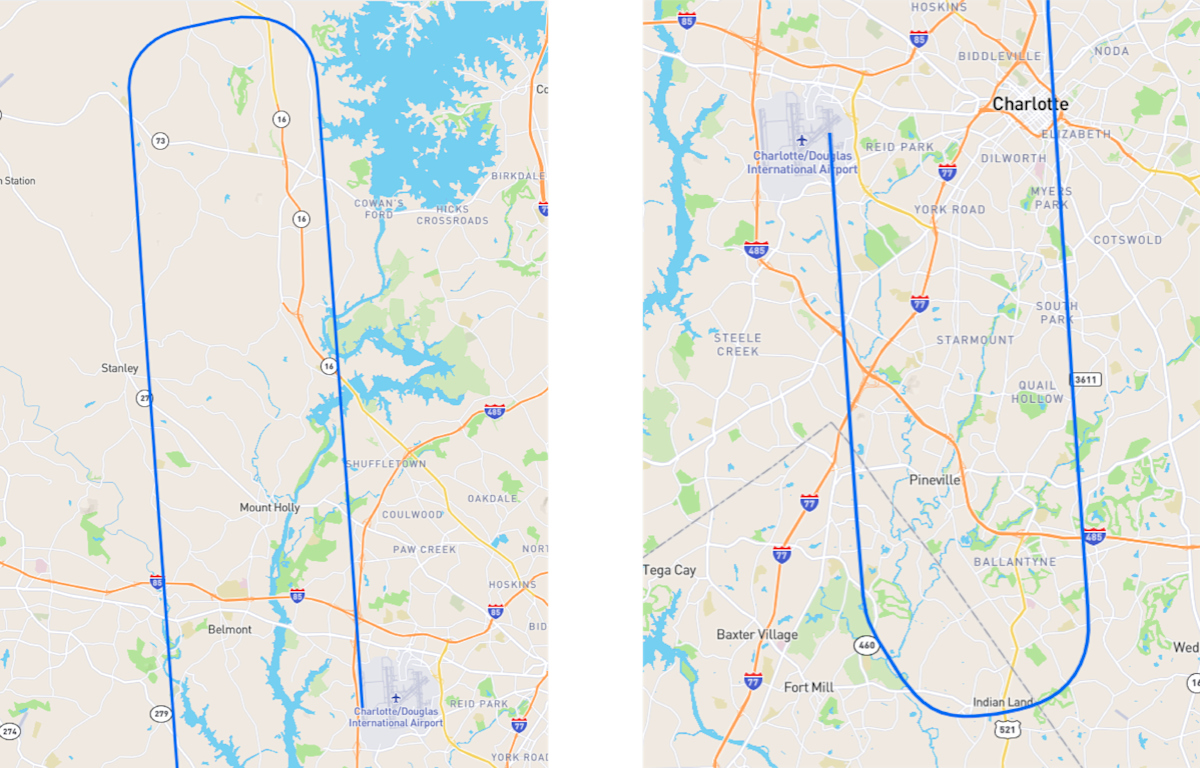
Traffic flow direction is primarily determined by wind conditions, both at the surface and aloft. Aircraft typically take off and land into the wind for safety and performance reasons. However, other factors also influence the decision:
• Weather: If severe weather is present in one direction (e.g., thunderstorms to the south), ATC may choose the opposite flow, even if surface winds are light.
• Low Visibility: During low ceiling or low visibility conditions, Charlotte Douglas (CLT) operates more efficiently in a north flow due to limitations in the instrument approach systems used for south flow.
• Tailwinds: ATC may allow operations with a light tailwind in certain conditions, but only if it’s safe to do so. Strong tailwinds prevent this option.
• Calm Conditions: When winds are calm and no other factors apply, the preferred direction is north. This improves ground efficiency, as most ramp congestion is on the north side, and taxiing south to depart helps reduce that congestion faster.
ATC decisions are based on real-time safety and efficiency considerations to ensure the safest and most reliable operations possible.
Charlotte Douglas International Airport (CLT) operates 24 hours a day to support a wide range of essential aviation activities. These include passenger flights, cargo operations, medical transport, and emergency services - all of which may be scheduled or needed at any time of day or night.
While flight activity does decrease significantly during late night hours, CLT is a major hub airport, and overnight operations are often necessary to support airline schedules, aircraft repositioning, and time sensitive cargo. The airport is also part of the National Airspace System, which includes many other 24/7 airports that rely on continuous connectivity.
Completely closing the airport at night is not practical or feasible, as it would disrupt national air traffic flow, limit critical services, and reduce the airport’s ability to serve both the local community and the broader transportation network.
Aircraft departing to the north from Charlotte Douglas International Airport (CLT) remain relatively low for several miles due to air traffic control procedures and the surrounding airspace. After takeoff, planes must follow specific departure paths and altitudes to safely integrate with other air traffic, including arriving aircraft and traffic from nearby smaller airports.
Additionally, aircraft are managed within controlled climb corridors to ensure safe separation from other flights. Controllers may delay climb until the aircraft is clear of certain areas or until other traffic has passed. This is especially true in busy or complex airspace like the Charlotte region.
Aircraft altitude is carefully managed for safety, efficiency, and coordination with the broader air traffic system.
If you’re noticing frequent turns overhead, your home may be located beneath a common "base leg" segment of arriving aircraft. A base leg is part of the standard landing pattern similar to a U-Turn, where planes begin turning toward the runway for final approach.
At Charlotte Douglas International Airport (CLT), aircraft often make these turns several miles from the airport to line up properly with the runway. These turning points are determined by air traffic control to safely sequence aircraft and maintain efficient spacing, especially during busy arrival periods.
Because the base leg can cover a wide area, some neighborhoods may experience more noticeable aircraft noise from turning planes, particularly when weather, runway use, or traffic volume requires consistent use of that path.
Air Traffic Control works within strict safety parameters and national procedures when directing these turns, but we understand the impact can be noticeable in affected areas.
The primary reason the east downwind leg is lower than the west is to allow two aircraft to turn base leg toward the runway at the same time - one from the east side and one from the west without merging at the same altitude.
To ensure safe separation, air traffic control assigns different altitudes to each aircraft. The aircraft on the east side typically flies about 1000 feet lower, while the aircraft on the west side remains higher during the downwind. This vertical separation allows both planes to turn safely toward final approach from opposite sides of the airport without converging at the same altitude.
Additionally, the east side is often the final portion of the downwind leg before the aircraft begins its base turn, so it is already descending in preparation for landing. On the west side, aircraft are still entering or early in their downwind segment and may not begin their descent until they are closer to the airport.
This coordinated altitude difference is a standard and necessary part of safe and efficient arrival procedures at CLT, especially during high traffic periods.
Planes sometimes begin their final turn to line up with the runway well before reaching the airport - sometimes as far as 30 miles out - to ensure a smooth, safe, and efficient approach. This early turn allows aircraft to gradually reduce speed and altitude in a controlled manner while maintaining separation from other traffic.
At Charlotte Douglas International Airport (CLT), which handles a high volume of flights, early sequencing and spacing are essential. Air Traffic Control directs these longer final turns to organize arriving planes safely into the landing pattern, minimize delays, and accommodate complex airspace and weather conditions.
Starting the final turn farther out helps pilots prepare for landing well in advance by reducing speed and altitude gradually, which contributes to safer more predictable arrivals.
Air Traffic Control (ATC) continuously works to balance safety, efficiency, and community impact when managing arrivals at Charlotte Douglas International Airport (CLT). Runway use and approach paths are determined by wind direction, weather conditions, and operational considerations to ensure safe takeoffs and landings.
While ATC does have some flexibility to switch runways, it’s not always possible to alter final approach paths significantly. Factors like:
• Prevailing winds: Planes must land into the wind for safety and performance.
• Instrument approach procedures: These are carefully designed and approved paths that aircraft must use during arrivals, especially in low visibility or poor weather.
• Airspace and traffic flow: CLT operates in complex, busy airspace that requires maintaining safe spacing and sequencing between aircraft.
Because of these constraints, some neighborhoods may experience more concentrated flight paths if they are in a direct line relative to a runway.
Metroplex (short for Metropolitanplex) was an FAA program completed in 2017, aimed at modernizing and optimizing air traffic routes in busy metropolitan areas using advanced GPS-based navigation. The goal is to improve safety, increase efficiency, reduce fuel consumption, and decrease overall environmental impact.
Because Metroplex designs more precise flight paths, it can concentrate aircraft over narrower corridors. This means planes may fly more consistently over certain neighborhoods than before, which can lead to an increase in noticeable noise for those communities.
While Metroplex helps reduce emissions and improve airspace efficiency overall, some areas may experience changes in flight patterns and noise levels. The FAA and Airport continue to monitor noise impacts and explore ways to balance these benefits with community concerns - for Metroplex 2.0 which is currently under consideration.
Divergent headings refer to variations in the flight paths that departing aircraft follow after takeoff. Instead of all planes flying the same exact route, the idea is to spread departures over multiple paths to reduce noise concentration over any single community.
As part of the Airport’s proposed flight path changes, Charlotte Douglas International Airport (CLT) is advocating for divergent headings to help distribute aircraft noise more evenly across a wider area.
For communities, this means departures might be less concentrated over one neighborhood, potentially reducing the frequency and intensity of noise exposure. However, because aircraft still need to fly safe and efficient routes based on airspace design, weather and traffic, divergent headings may not eliminate noise entirely but aim to balance it more fairly.
What you are most likely hearing is late night engine testing, known as "engine run-ups," which is typically required after maintenance work to ensure an aircraft’s engines are operating safely and within required standards. These tests involve running engines at various power settings - sometimes at high thrust - while the aircraft remains stationary.
These procedures are critical for safety and compliance. Airlines often operate on tight schedules, and maintenance is frequently performed overnight when aircraft are not scheduled to fly. As a result, required engine tests may occur during late night or early morning hours.
Airports usually have designated run-up areas and may observe noise abatement procedures, but not all tests can be delayed or relocated. The timing and location of these run-ups are often influenced by FAA regulations, operational demands, and aircraft availability, all of which prioritize ensuring aircraft are safe for their next scheduled flight.
It’s not always practical or safe to route arriving aircraft over roads or unpopulated areas to reduce noise. Arrival paths are carefully designed with safety, efficiency, air traffic control, terrain, weather, and the need to coordinate with other flights in mind.
Here’s why planes can’t simply avoid populated areas:
• Safety and Efficiency: Aircraft must follow precise routes to stay safely separated and operate efficiently within busy airspace.
• Air Traffic Flow: Controllers manage many flights at once. Standardized paths help ensure smooth, predictable operations.
• Descent Requirements: Planes need specific paths and speeds for stable landings. Deviating too much can affect safety.
• Runway Alignment: Aircraft must line up with the runway from specific directions, which may not follow roads or avoid neighborhoods.
Both the FAA and the Airport regularly review procedures to reduce community noise whenever possible, but safety and efficient operations always come first.
You can escalate your concerns to the Federal Aviation Administration (FAA), which oversees flight paths and airspace use.
The FAA offers several ways to file a noise complaint:
• FAA Noise Ombudsman – Serves as a public liaison on aviation noise issues. You can contact the Southern Region office at 9-ASO-NOISE@faa.gov or call 202-267-8507.
• ANCIR System – The Aviation Noise Complaint & Inquiry Response (ANCIR) The system allows you to submit noise complaints online by FAA portal. Visit https://ancir.faa.gov/ancir to file a report. Include as much detail as possible, such as the date, time, location, and nature of the noise disturbance.
These avenues connect you directly with the agency responsible for regulating aircraft operations and managing U.S. airspace.