Iconic Mobile Moves to New Location
CLT’s iconic “First in Flight” aviation mobile has moved to its new home on Concourse D.
The kinetic sculpture and clock tower, created by the late sculptor George Greenamyer (1939-2023), hung in the Atrium from 1997 until it was removed in 2025 for cleaning and relocation.
The move will improve sightlines, offer a view of uptown Charlotte and maintain public access.
“Over the years, the terminal has undergone numerous construction projects, renovations and expansions to introduce new amenities, services and concessions, all while supporting a growing number of travelers,” said Lauri Golden, Customer Engagement Manager.
“With these improvements, the opportunity emerged to relocate the mobile to a space that offers greater visibility of the sculpture’s many features as well as views of the Charlotte skyline,” added Golden. “Its new location complements the renovation of this concourse, which features a range of enhancements and upgrades—highlighted by the First in Flight mobile.”
16 Flying Machines Featured
“First In Flight” features four levels and 16 different flying machines that circle the clock tower, each representing a significant element of aviation history.
The handcrafted metal pieces feature the Wright Brothers Flyer, a steam-powered helicopter, a Dornier flying boat, the Space Shuttle, Charles Lindbergh’s “Spirit of St. Louis,” a Graf Zeppelin, a Douglas DC-3, and a paper airplane, inspired by a congratulatory letter from former CLT Airport Director Jerry Orr to Greenamyer, the selected artist.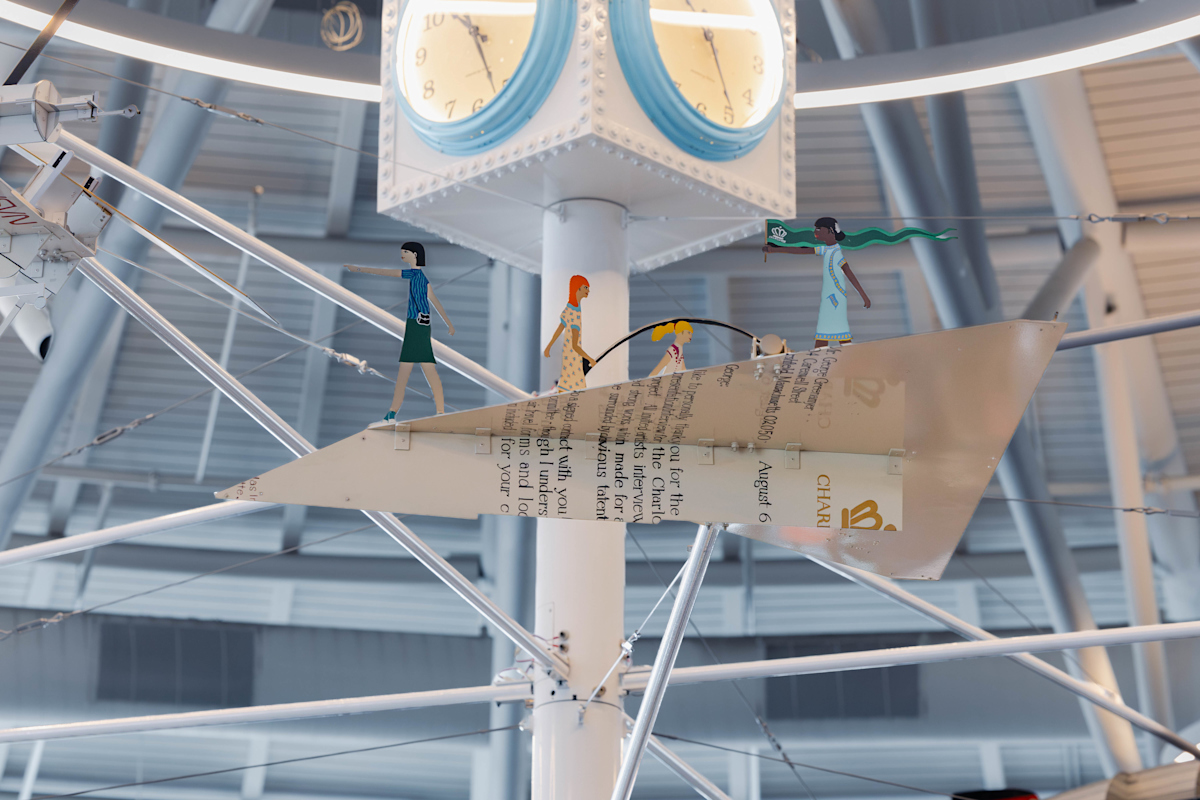
Atop the mobile is an analog clock featuring an employee in a US Airways uniform, a nod to the Airport’s hub status. (Piedmont Airlines merged with USAir in 1989 and later changed its name to US Airways in 1997.)
Extensive Planning Required
The relocation of the mobile onto Concourse D required extensive planning and collaboration among multiple Airport departments, including Maintenance, Airport Development and other key stakeholders and contractors.
Coordinating the installation with the ongoing renovation project was essential to ensure the artwork could be safely installed while minimizing impacts to Airport operations and construction activities.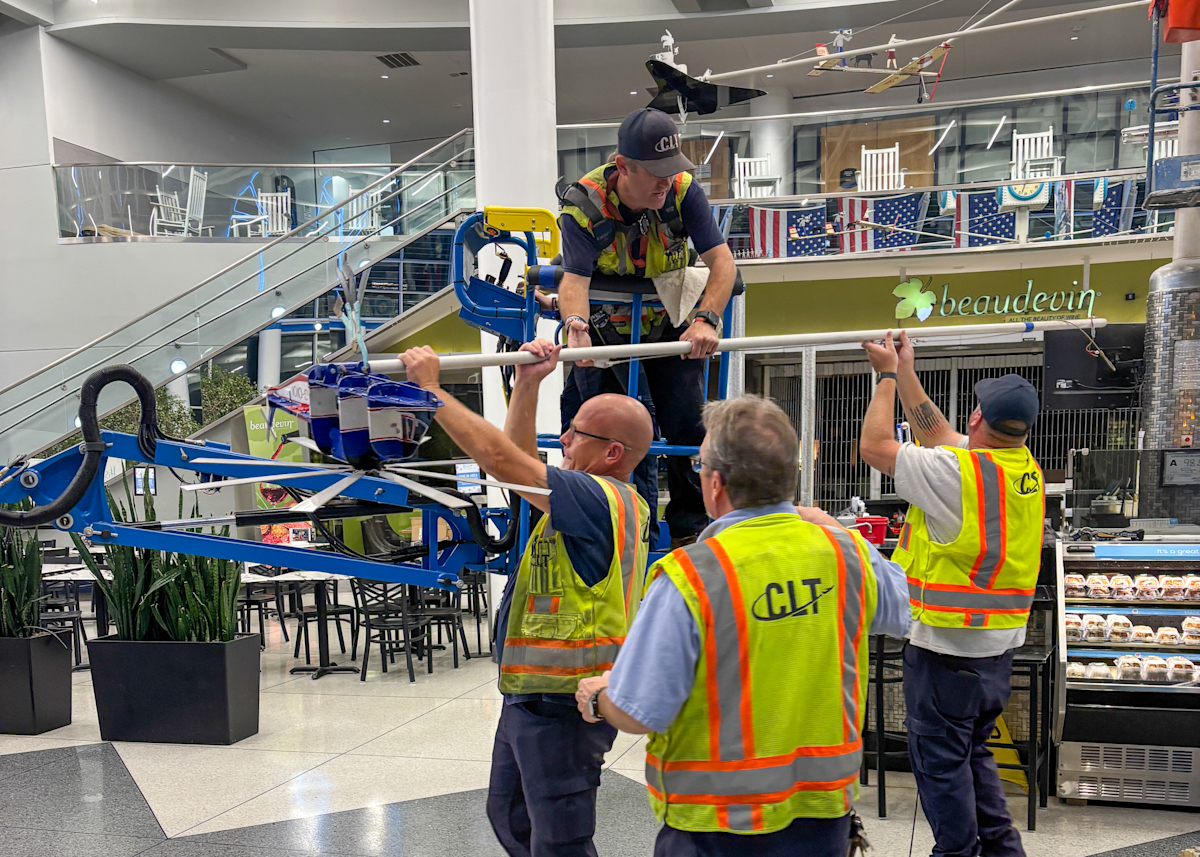 (Pictured Above: September 2025 removal)
“The first phase of the project involved removing the mobile from the Atrium and transporting it to the Airport's art warehouse,” said Charles Tabor, CLT Exhibit and Amenity Lead. “Due to the size and complexity of the artwork, the removal was completed over the course of three overnight shifts.”
“While the mobile was in storage, it underwent a comprehensive restoration that included professional cleaning, repainting and the replacement of several mechanical components to ensure its long-term stability and operation,” added Tabor.
Charlie King, CLT Chief Maintenance Mechanic, has maintained the mobile throughout his 31-year career at the Airport and said there are specific challenges with a kinetic mobile.
“Years ago, we tried to start and stop the mobile at night and in the morning,” said King. “Eventually we figured out that it was better to leave it running at a low speed all the time, 24/7. That’s because it takes so much torque to start all four sections, and once it gets up to speed, it takes very little effort to keep it going because of momentum. We replace the roller bearings on a 6-month schedule.”
Still To Come In 2026-27
A new art installation by artist Lynn Basa is also coming to Concourse D. The metal wall sculpture, called “Terminal Velocity,” will be placed at two sites near gates D8 and D9. The installation should be completed by mid-November 2026.