Lifesaving Resources at CLT
No one expected a passenger to suddenly go into cardiac arrest at Gate A6 on Aug. 5. Luckily, American Airlines staff knew what to do and found the necessary equipment nearby. As Medic rushed to the scene, Manager of Customer Operations Abigail O’Neal, Captain John Frankhouser, Flight Attendant Jana Arlene Pochintesta and Customer Service Agent Lorice Craig had already jumped into action.
“I was boarding a flight at the gate, and I heard someone fall, it was a loud boom,” Craig said. She looked toward the sound and saw a man lying on the ground. His face had turned a burgundy color, and she quickly rushed over to help. “I put his head on my knee, and he then had three or four seizures before having a heart attack,” Craig added.
About 10 years ago, Craig jumped in to help someone having a similar experience on Concourse B. Back then, there were fewer Automated External Defibrillators (AEDs) nearby. An AED is a portable medical device that checks a person's heart rhythm during sudden cardiac arrest and delivers an electrical shock if needed to restore a normal beat.
Thankfully, many AEDs have been added to the terminal since then and her fellow American Airlines crew members didn’t wait to jump in and help. O’Neal was heading to lunch when the incident happened, while Craig, Pochintesta and Frankhouser were not working at the time.
“My wife and I were here to catch a flight, and I saw him (the man on the ground) and all the hubbub happening,” Frankhouser said. “I went over and saw he was face down, so I turned him over to the recovery position.”
Around that time, O’Neal also saw the incident and focused on crowd control. “I just stepped in to make sure everyone was out of the way, and I called for help,” O’Neal said.
Pochintesta noticed everything going on while walking to catch a flight home. Her first thought was to grab an AED. “I knew they (AEDs) were nearby. I just felt like the more people that could help the better and that an AED would be a good tool,” Pochintesta said.
In emergencies, every minute counts and the quick actions of the American Airlines team at CLT played a big role in helping save the man’s life. AEDs are just one of the many potentially lifesaving resources and personnel in and around the Airport. Find out below what other equipment and staff are located throughout the Airport to help ensure the safety of passengers and employees.
Automated External Defibrillators (AEDs)
Currently there are 200 AEDs at the Airport. They can be found throughout the terminal lobby, Atrium, concourses and in each building on Airport property, usually stored in a glass cabinet attached to a wall. More will continue to be added as the Airport expands. In the terminal, some AED cabinets also include tourniquets and Stop the Bleed kits.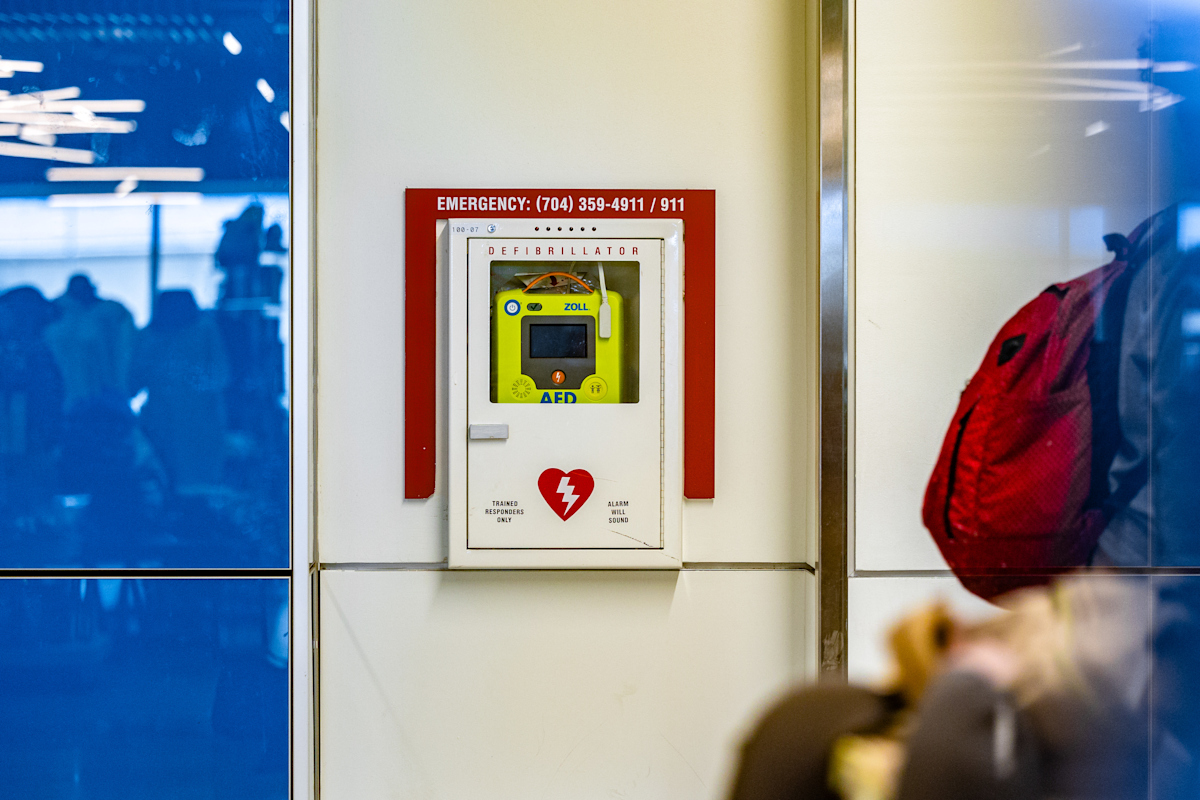
Earlier this year, CLT was honored by Medic with the Braveheart Award for its AED program. From March 1, 2010, to July 20, 2025, there were 180 cases of cardiac arrest on Airport property. CLT currently has a 60% USTEIN survival rate, which measures the survival rates of cardiac arrests.
Watch how to use an AED.
Medic Onsite
The Airport has maintained a contract with Medic since 2012 for its services. Medic responds to medical incidents (everything from a request for a band-aid to cardiac arrests) in the terminal from 7 a.m. to 11 p.m. throughout the week. After 11 p.m. any Medic needs are requested through the 911 system.
There are usually four Medic personnel working on-site at a time, two are Emergency Medical Technicians (EMTs) and two are paramedics. They have an office on Concourse A that serves as a base, though often they can be found traveling throughout the terminal either responding to calls or working to familiarize themselves with the Airport. Medic has two primary carts for its personnel use along with a special cart stored on Concourse E that allows access from the stairs to the concourses.
Medic crews stay busy in the terminal, often responding to 10-15 calls per day, many times traveling to one call right after another. From January to June this year, Medic has responded to 3,066 medical incidents at CLT.
“Having public safety personnel within the confines of the Airport is about preparedness, a quick response and efficient recovery from all types of emergencies and incidents,” said Emergency Operations Manager Michael Tobin. “In a rapidly changing and complex environment where time is of the essence; the readiness, expertise, and swift response of our public safety partners is paramount in our everyday operations.”
Charlotte Fire Department
Currently there are two fire stations at CLT and a third that broke ground in May, which is expected to open in May 2027. Read about the new station here.
Those stations respond to any potential incidents on the airfield along with inside the terminal. In addition to the fire stations, Charlotte Fire staffs two EMTS on mountain bikes inside the terminal equipped with medical equipment from 8 am to 8 pm four days a week.
The Charlotte Fire EMTs assist Medic with medical emergencies but also respond to elevator entrapments and any fire-related incidents.
Charlotte Mecklenburg Police Department
The Charlotte Mecklenburg Police Department (CMPD) has an office on-site in the basement of the terminal.
It is common to see officers throughout the Airport at varying times during the day. CMPD patrols the Airport via vehicles, bikes and on foot. No matter the time or the day, CMPD has a 24-7 presence on Airport property.
First Aid Kits and Fire Extinguishers
First aid kits are not accessible to the public but can be found in CLT breakrooms and buildings. Fire extinguishers are located around 75 feet apart in the terminal and in Airport buildings.
“At CLT, safety is our top priority,” said Director of Risk, Safety & Health Ella Moultrie. “We are committed to providing the essential safety and emergency equipment needed to protect the health and well-being of everyone who travels through or works at our Airport. By ensuring access to critical resources, including AEDs, fire extinguishers, and first aid kits, and equipping our employees with the training and preparedness needed to respond effectively to emergencies, we strive to maintain a safe and secure environment for our passengers and employees.”
This month CLT is celebrating recertification of its Cohorts I and II under the Carolina Public Sector Star certification program. The Airport is the only operator in the country with such a designation. The Carolina Star program Is operated by the North Carolina Department of Labor. It recognizes employers and employees who have implemented effective safety and health management systems.