The Following Weeks, Months and Years
When the terrorist attacks occurred on September 11, 2001, CLT was the 21st busiest airport in the world and the busiest hub for US Airways.
By comparison, it is now the world's seventh-busiest airport for aircraft operations and the second-largest hub for American Airlines. (US Airways merged with American Airlines in 2013.)
Travel Drops Off
In the weeks immediately after 9/11, air travel dropped off dramatically. Many people feared flying or travel in general, and airlines began reducing their schedules.
CLT temporarily lost several routes, including those to Montreal, Paris, and Frankfurt, Germany. According to news reports published in The Charlotte Observer from late September 2001, US Airways reduced its capacity by 23%, resulting in layoffs of about 1,700 employees in Charlotte.
In October 2001, the first full month after 9/11, CLT’s total passenger traffic fell 19% from the same time period the previous year. It took two years for passenger traffic and aircraft operations at CLT to return to October 2000 levels.
U.S. Airways Hit Hard
Charlotte-based journalist and author Ted Reed has covered the aviation industry for 35 years. He currently covers the Airport for The Charlotte Ledger.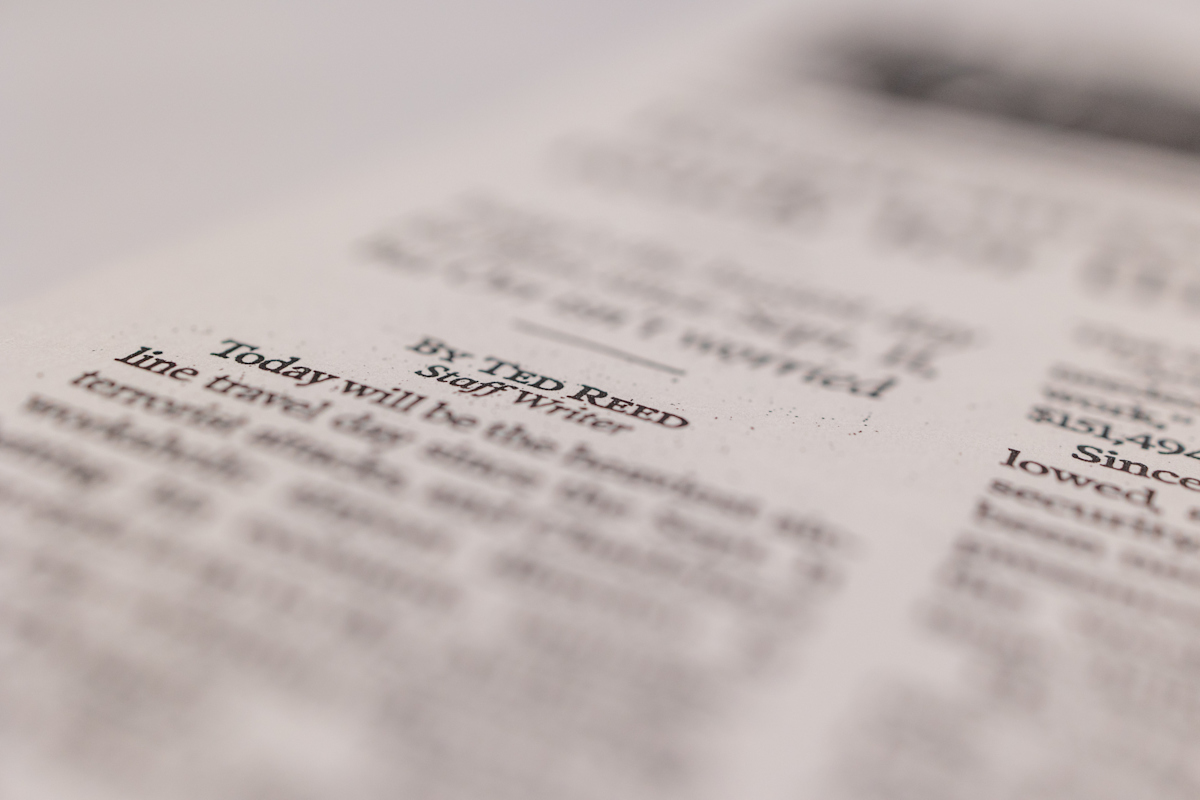
“The Sept. 11 terrorist attacks came just two months after the US Airways/United deal (proposed merger) fell through. The attacks exacerbated the problems of an already weak airline economy, bringing a sudden sharp decline in traffic that led to huge numbers of losses and layoffs,” wrote Reed.
“The domestic industry’s revenues fell to $107 billion in 2002, down from $130 billion in 2000, while domestic airline employment fell to 450,000, down from 520,000 in 2000. US Airways was particularly hard hit because 80% of its departures were on the East Coast, where travel fell precipitously, and because Washington’s Reagan National Airport, where US Airways was the dominant carrier, was closed for three weeks.”
Creation of the TSA
One of the biggest changes after 9/11 was the creation of the Transportation Security Administration (TSA), the first new federal agency in decades. Nearly 30,000 workers were hired to screen baggage and passengers at the nation's airports.  (Pictured: TSA officer at CLT, Early 2000's)
Before that, the Federal Aviation Administration (FAA) directed airlines to provide screening or contract for security screening.
According to the official TSA website timeline, President George W. Bush signed the Aviation and Transportation Act in November 2001.
It required federal officials to conduct screening, required 100% of checked baggage to be screened, expanded the Federal Air Marshal Service and ordered reinforced cockpit doors.
In 2002, CLT had five security checkpoints and several baggage screening locations. Today, the Airport has three larger checkpoints with 21 total lanes and two in-line baggage screening locations, staffed by about 600 local TSA employees (Fifteen TSA hires from the original 2002 class remain at CLT today!)
“Through 25 years of continued evolution, passengers in the nation’s transportation system are safer and more secure than ever before,” said CLT Acting Federal Security Director Jose Bonilla.
“The Transportation Security Administration works diligently to remain steps ahead of the persistent and evolving threat, while also working to significantly improve the overall passenger experience. We fully recognize that security and efficiency are opposite sides of the same coin, and I think the trend and progress will continue through the next 25 years.”
Other Security Measures Added
CLT and the FAA implemented several other security changes in the days, months, and years that followed the 9/11 attacks, including but not limited to:
-
Only ticketed passengers, airline-badged personnel, and airport-badged personnel are allowed through security checkpoints.
-
Curbside check-in service was discontinued (although SkyCaps were available for baggage assistance).
-
Vehicles parked in CLT decks were subject to inspection. Vehicles that could not be visually inspected were asked to park in surface lots.
-
Knives and box cutters are banned from carry-on luggage.
In August 2006, TSA put additional precautions in place. The agency began requiring passengers to remove shoes to screen for explosives, and banned liquids, gels and aerosols from carry-on luggage (later amended to allow for 3.4 ounces or less).
Goodbye to Goodbyes
With advanced technologies like facial comparison and other enhanced screening capabilities, some of these policies have since been adjusted or eliminated (for example, the “Shoes Off” policy ended in July 2025).
However, the days of greeting friends and family at the gate, waving goodbye to loved ones as they board, or coming into the terminal just to eat, shop, or hang out are gone. They have been replaced by a “new” normal that still exists today.