People & Profiles
Feb 24, 2026Nature’s Caretakers: Wildlife Group Helps Protect Airfield
Planes aren’t the only things that make their way onto CLT’s airfield. From deer to birds, to coyotes and more, keeping wildlife off the airfield is a daily job.
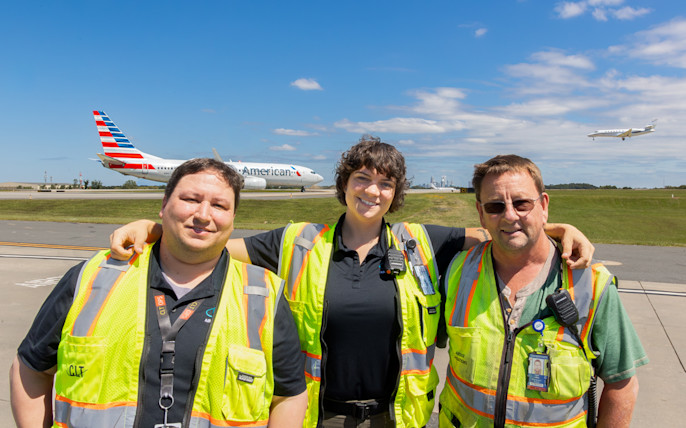
To help ensure Airport safety, the Airside Operations Wildlife Management Team relocates and discourages animals from seeking out the airfield. The group includes __Airport Wildlife Programs Supervisor David Castañeda__ and __wildlife coordinators Cory Davis__ and __Tayler Caudle__.
“The program is to ensure FAA compliance for wildlife hazard management,” Castañeda said. “Our responsibility is to mitigate those risks as much as possible to create a safe operating environment for aircraft.”
Recent stats show how busy they are:
- CLT had approximately 42 wildlife strikes per 100,000 aircraft movements in 2024.
- 71 different species were identified in CLT wildlife strikes in 2024. Of these species. 88% were birds, 10% bats, 1.6% terrestrial mammals and 0.4% reptiles
- The Airside Operations Wildlife Management team has worked with the United States Department of Agriculture Wildlife Services to trap/band for ID/relocate over 174 birds overall since 2021.
Birds are the biggest issue, but other wildlife can be problematic too. While Castañeda oversees the group, Davis and Caudle address wildlife concerns in and around CLT. Castañeda also assists them when necessary. “I look at a lot of statistics and numbers and try to just direct them in the right direction like, maybe we need to look at this or maybe we need to focus really on this species and or this problem,” Castañeda said.
He has worked in his current position for 13 years. In 2018 Davis joined him and Caudle became the newest member of the group in 2024.
“I’ve been building up this program and they’ve (Davis and Caudle) have made it really awesome,” Castañeda said. “I want to continue making it bigger and better and to contribute more to making this Airport a safer place,” Castañeda said.
A normal day for Davis and Caudle involves monitoring wildlife, addressing any concerns and responding to any immediate wildlife issues.
“I typically do a circle around the Airport a couple of times depending on the time of year because certain things change depending on the season,” Davis said. “I might also go outside the fence looking for geese, ducks, things like that in the ponds nearby. Those are the birds that are the most dangerous for airplanes because they have big mass and weigh more so they can cause more damage.”
They also pay attention to small spaces around buildings where birds and other animals make homes. The goal is to not only safely remove wildlife to avoid hazards on the airfield, but to also discourage animals from wanting to be at the Airport. Tactics the group uses include approaching animals with loud noise-making tools to scare them off, physically catching and removing animals and other options are sometimes needed.
One hard part about their work, according to Davis, is seeing the same animals continually return, which can be frustrating but looking at the data they collect regularly, the work they do is making a difference. “I said, 'I don’t think these birds are ever going away' and Castañeda pulled out the paperwork and said, 'You've been here three years — look at the numbers. See how many birds you saw this year compared to last year? You've seen only about half as many as four years ago. You are making a difference,'" Davis said.
For him, the job differs from day to day. “We’ve been out here at 3 o’clock in the morning chasing deer off the airfield before. That’s the kind of thing that fascinates me,” he said. “It gets into a routine sometimes, but an odd day pops up every now and then that you weren’t expecting.”
One of those days happened recently when Davis found himself covered in muddy, swampy water. while working to remove birds from Airport property. While doing so, his boot got stuck in thick mud, and he ended up falling into a creek.
“I didn’t see that on my calendar that day, and there I was in the creek and it’s cold,” Davis said. “You can’t predict this stuff, it just happens. I just got out of the mud and my boot stayed in the mud.” (He laughed about it and made sure to ask Castañeda for more boots after.)
Another interesting aspect of their job is the unique animals spotted near the airfield. For instance, once someone saw a peacock, but the strangest call for Davis was about a beaver.
“They said it was over at the gate by an airplane, and I was thinking there is no way, but sure enough there was a beaver,” Davis said. Along with a beaver, a woodchuck was found taking a nap on a hot day by an airplane tire a few months ago.
Caudle is the newest member of the group. While Davis works the morning shift, Caudle can be found in the late afternoon and evening. Their work is similar, but she feels Davis sees more bird activity due to the time of day he works. She usually sees more mammals in the evenings and is also heavily focused on studying the ecology aspects of what they do.
“My big thing I am really passionate about is wildlife behavior and the ecological relationships,” Caudle said. “This includes looking at what plants are attracting what animals and what animals are attracting other animals. It’s a domino effect.”
Caudle is currently in school training to become an airport biologist. She enjoys the variety and challenges of her daily duties at the Airport.
“This job has been so frustrating but in the best way to me because it is like playing chess every single day,” Caudle said. “I am constantly trying to figure out the patterns of these animals and what they are doing next, how I make it stop and what can I do to get two steps ahead.”